






This case could have easily gone in the wrong direction, and it’s a great example of when it’s helpful to have data from HTMA + an additional lab (in this case an Organic Acids Test) so I want to break this down for you.
Before I get into it – this is a complex case and isn’t the right fit for every practitioner’s personal scope, but my hope is that you see what’s possible with the right education! Labs are so cool 🤓
Also… I know how tempting it is to start problem-solving halfway through, so before you think about what you would’ve done here, read this all the way through.
This case is about a 3-year-old boy whose symptoms escalated after confirmed mold exposure, despite his parents doing almost everything “right.”
He was presenting with:
- Eczema
- Difficulty falling asleep
- Significant speech delay
- Emotional dysregulation
- Behavioral patterns raising concern for possible ASD
The symptoms began after mold exposure at a family member’s home. What started as hives and swelling slowly evolved into something more layered.
And like many of the families you probably work with, they have already done so much.
- Removed gluten and dairy
- Cleaned up his diet significantly
- Eliminated dyes, preservatives, and processed foods
- Invested in OT, PT, and speech therapy multiple times per week
Despite all of that, progress had plateaued.
When you’re sitting across from parents who are scared and hopeful at the same time, the pressure to “do something big” is real. Especially when mold, behavior, and regression are part of the picture.
- It would have been very easy to push detox.
- Very easy to start aggressive antimicrobials.
- Very easy to try to “fix” what looked urgent.
And everything about the surface presentation could have justified that approach.
However, before making any decisions, we ran an HTMA and paired it with an Organic Acids Test.
What emerged was not a simple “kill what’s overgrown” case. It was a layered terrain issue.
From the HTMA, several patterns stood out immediately:
- Tissue calcium was significantly low.
- Sodium and potassium were elevated together, pointing toward a sustained stress response.
- Copper was suppressed relative to zinc.
- And multiple heavy metals were present with toxic ratios suggesting mineral displacement.
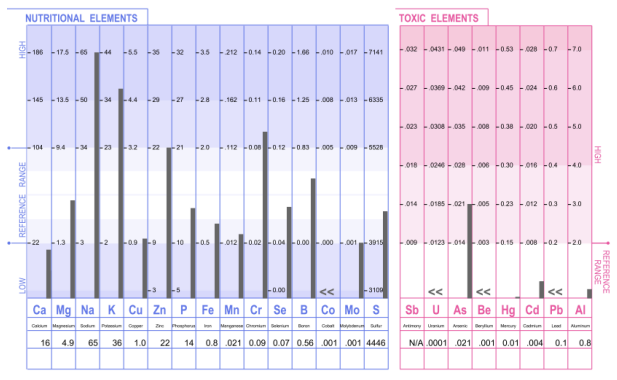
Individually, you could react to each of these. But together, they painted a picture of a system already under strain.
When we layered in the OAT, the pattern became clearer:
- Fungal overgrowth
- Clostridia elevation (HPHPA)
- Oxalate burden
- Mitochondrial stress
- Neuroinflammation
- Impaired detox capacity
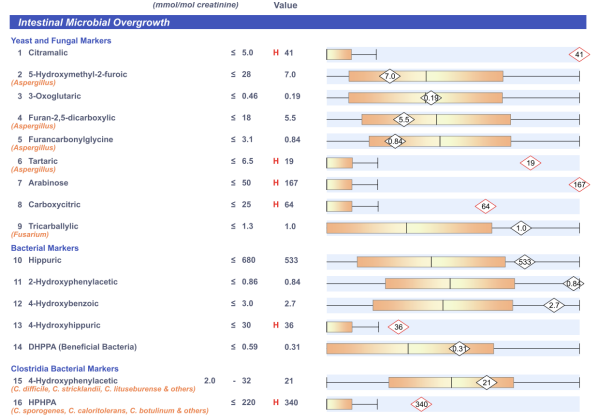
This was not a body asking for intensity. It was a body asking for stability.
If we had gone straight to aggressive antifungals or pushed detox hard because of the mold history, we likely would have overwhelmed a system that was already struggling to regulate.
And in a child this young, it’s so important to have this information.
So instead of leading with eradication, we led with foundation.
- We focused first on drainage and bile flow.
- We supported digestion.
- We repleted minerals appropriate for a fast oxidizer.
- We worked to calm neuroinflammation.
Only once his system showed signs of improved resilience did we address clostridia and fungal load, slowly and deliberately.
Here’s the part I want you to sit with:
The labs did not just give us windows into what was going on… They told us what he could tolerate.
Without HTMA guiding the mineral terrain, this easily could have become an aggressive detox case. And on paper, that would have looked proactive. In reality, it likely would have overwhelmed him. Not because detox is wrong, but because timing is everything.
A stressed nervous system does not respond well to force… it responds to stability.
If you miss that, you can follow every “right” step and still move the case in the wrong direction.
And that difference changes outcomes.
P.S. This case is fully de-identified and shared for educational purposes.
This is what happens when HTMA is interpreted the way it was meant to be.
Not as isolated numbers.
Not as quick fixes.
But as a meaningful pattern that tells a deeper story.
When you learn how to see what others miss, your recommendations become more targeted, your clients feel more supported, and your practice starts to grow in a much more sustainable way.
If you’re ready to learn how to approach HTMA like this, watch my free on-demand training where I walk you through exactly how I interpret results step by step.