




More testing doesn’t automatically mean better client outcomes. Most practitioners don’t have an information problem, they have a prioritization problem. This post explains why stacking labs (DUTCH, GI-MAP, mold, food sensitivity, blood work) often overwhelms clients instead of helping them, why the body doesn’t heal in separate categories, and why starting with a thorough intake and HTMA helps you assess the foundation before ordering deeper tests. Key takeaway: before running another panel, ask “what information would actually change my recommendations?”.
In functional health, it’s easy to assume more information leads to better outcomes. More labs. More biomarkers. More supplements. More data.
I get the pull. I love testing. My company is literally called Test Don’t Guess.
But after years of working with practitioners and reviewing client cases, I keep seeing the same thing: most clients don’t need more data. They need a better plan for the data they already have.
The biggest obstacle to progress usually isn’t a lack of information. It’s information overload.
The functional health trap
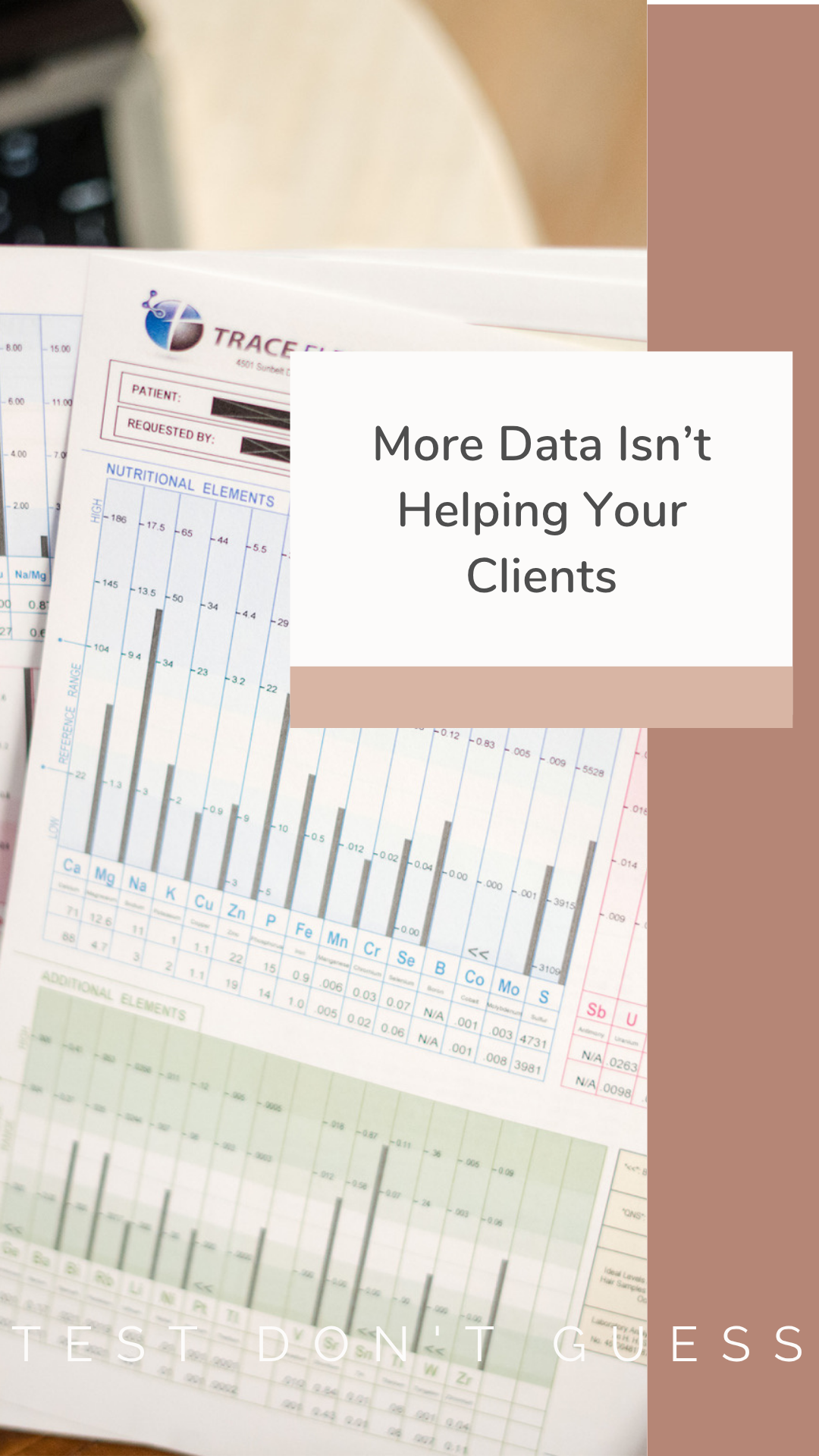
A client comes to you exhausted, anxious, bloated, and overwhelmed. A few months in, they’ve got a DUTCH test, a GI-MAP, a food sensitivity panel, a mold test, blood work, and a supplement cabinet that looks like a small pharmacy.
And they still don’t feel much better.
The problem usually isn’t that any one test was wrong. It’s that every test handed them one more thing to fix. Now they’re supporting hormones, healing the gut, detoxing mold, balancing blood sugar, and chasing nutrient gaps all at once.
Instead of getting clarity, they got buried.
Every test creates a decision
When you order a test, you’re not just gathering information. You’re creating decisions.
More tests means more findings. And more findings makes it harder to answer the questions that actually matter:
- What matters most
- What to address first
- What’s a cause versus a consequence
- What’s just the body adapting
This is how practitioners end up with complicated protocols that never move the needle. They’re trying to do everything at once.
The body doesn’t heal in categories
One of the biggest things HTMA taught me is that the body doesn’t sort itself into neat boxes. Your client doesn’t have a hormone section, a gut section, and a stress section. It’s all connected.
The hormone symptoms might really be poor stress resilience. The digestive symptoms might be mineral depletion. The detox struggle might be a body without enough reserve to detox in the first place.
When you zoom in too tight on one finding, you lose the bigger picture.
Why I start with foundations
This is why I usually start with a thorough intake and an HTMA. Not because HTMA answers everything. It doesn’t. But it shows me the foundation before I decide whether deeper testing is even worth it.
I want to know how the body is handling stress, whether mineral reserves look depleted, how resilient the nervous system is, and whether this client can even support a more advanced protocol yet.
Sometimes the answer is clear: they need more testing. Other times it’s simpler than expected. They need better sleep. More protein. Mineral support. Steadier blood sugar. A protocol with fewer moving parts.
And more often than practitioners expect, those foundational changes do more than the next expensive test ever would.
The most useful questions you can ask
Instead of “what test should I run next,” try this one:
“What information would actually change my recommendations?”
That question alone saves clients thousands of dollars and months of frustration. Because if the honest answer is “nothing,” then another test isn’t your next step.
When more testing does make sense
None of this means advanced testing is off the table. It’s genuinely valuable when it answers a specific question. Mold exposure, Lyme and co-infections, hormone metabolism, gut pathogens, real nutrient deficiencies all have their place.
The difference is strategic versus reactive. Run a test because it answers a question you can name, not because you’re hoping it’ll reveal something you can’t yet see.
The bottom line
The point of testing isn’t to collect data. It’s to help your client move forward.
Sometimes that takes advanced testing. Sometimes it takes stepping back and strengthening the foundation. The practitioners who get results are the ones who know which is which.
Your clients don’t care how many tests you ran. They care whether they’re sleeping, thinking clearly, feeling steady, and finally making progress. And often, the fastest way isn’t using more information. It’s using what you already have.
If you’re tired of guessing your way through client cases
This is exactly what I teach inside Instant HTMA Professional. Not more testing for the sake of testing, but a clear, repeatable system for reading a client’s foundation and knowing what to do first.
If you’ve got the credentials and the tests but still freeze when a real report is in front of you, that’s the gap I built this to close. Come learn the system I use on every case.
FAQs:
No. Advanced testing is valuable when it answers a specific clinical question. The goal is to test strategically, not just because a lab is available.
I ask whether the results would actually change my recommendations. If yes, it may help. If no, it’s usually better to implement the current plan first.
It shows mineral patterns, stress adaptation, and metabolic trends. That gives me a foundation before I decide whether more specialized testing is worth it.
Yes. Better sleep, protein, blood sugar, minerals, hydration, and stress support often shift how a client feels more than another panel would.
Trying to fix every finding at once. The best practitioners prioritize, simplify, and start with what moves the needle most.